
German Study Day at Goethe Institut
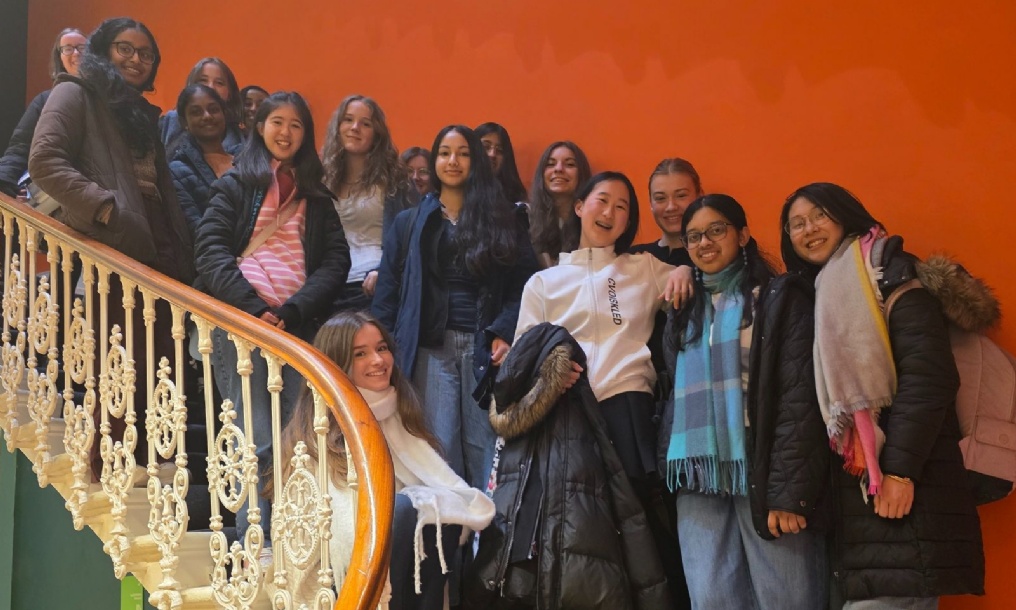
On Wednesday, 14th January, A-Level German students attended a Study Day hosted by the Goethe Institut, organised by the German Department of King’s College London. This provided us with a unique perspective on modern Germany's immigration history, which is particularly beneficial for our studies on immigration and multiculturalism as part of the A-Level course.
As it happened, the day started with a train delay. We had to wait in Reading for longer than anticipated, but luckily, half an hour later, we were on our way to Paddington, from where we took the tube to South Kensington. We made our way to the Goethe Institut, passing by the beautiful National History Museum on the way!
The day started with a lecture by Dr Katrin Schreiter, a German and History professor at King’s College, who specialises in events from the years of the Cold War. Her talk about modern German immigration history and the ways in which ethnicity and nationality were viewed in the post-WW2 years, was incredibly fascinating. We learnt many new things, such as the extreme left-wing, Marxist violence which was prevalent in the 1970s, most prominently by the Red Army Faction (RAF) in what would be known as the Deutscher Herbst – with protests, arson, and later even kidnappings and bombings. This homegrown left-wing terrorism later left a blind spot amongst many Germans towards future right-wing attacks, especially in the 1990s and 2000s, after reunification – where there was an upsurge in ethno-nationalist exclusionary political rhetoric, and even racial violence (including murder) by groups such as the neo-Nazi National Socialist Underground (NSU), whose purpose was to kill foreigners and German citizens of foreign origin – and for many violent attacks, a right-wing extremist motive was not the first motive suspected by the authorities (the aforementioned NSU went undiscovered for 13 years, despite their crimes being so high-profile). We found this blind spot especially interesting, given Germany’s history with right-wing extremism and their attempts to build up a racially blind state post WW2, where even censuses could not ask for race – it was fascinating to consider how much easier it becomes to forget the horrific consequences of past actions as time goes on.
We learnt a lot about what it meant to be a German citizen during the post-WW2 years, which raised a lot of questions about the role of the state towards its citizens versus foreign-born residents. For example, immediately after WW2, only people who were born to German citizens were considered German citizens, and becoming a citizen when you weren’t one was an incredibly complicated bureaucratic process. Then, in the late 1940s and 1950s, West Germany had a Wirtschaftswunder (‘economic miracle’) after loans from the USA’s Marshall Plan, which led to Gastarbeiter (‘guest workers’) from Turkey, Italy, Greece, etc, being invited to live and work in Germany. Despite their work, these people were not citizens and no effort was made to integrate them into German society. And in the 1970s, after the global oil crisis led to economic recessions worldwide, the West German government stopped the influx of Gastarbeiter, even promising them 10,000 marks to return to their country of origin. We also discussed similarities between Germany and England in this respect, such as how England had also invited migrants from the Commonwealth to fill labour shortages after WW2, which formed the Windrush Generation. It was interesting to consider how, in both countries, the invitation of migrant workers from more impoverished countries could, and often did, lead to increased racism and violence against minorities, and also a systematic ignorance around this. Dr Schreiter’s thought-provoking lecture provided crucial contextual background and laid the groundwork for our understanding of the film that would be shown later that day.
After lunch, we further explored how issues such as racism and xenophobia are portrayed through the lens of a film. Es Brennt (2023), directed by Berlin-based filmmaker and actor Erol Afşink, is his debut feature film. The film is about an Arab family who faced racial assault in Berlin, and the legal consequences that followed the incident. It is based on a true story from 2009, that of Marwa El-Sherbini, who was stabbed to death in a courtroom in Dresden, Germany by the defendant after testifying in a criminal case against his racist verbal abuse towards her. It was a special screening by the Goethe Institut, as the film is not yet available for streaming and has never been released in commercial cinemas.
The film does a very good job of juxtaposing normalcy and horror, effectively portraying the happiness of the family’s everyday life, and the way in which the incident slowly decimates it. We all found the ending incredibly shocking and thought-provoking. It was a powerful and unsettling reminder of how subtly racism is still intertwined with many people's everyday lives, and how it can keep morphing and resurfacing in different forms: such as the verbal abuse by the offender, the subconscious internal bias from the police, as well as the offender’s final physical assault. After taking some time outside and sharing some Kinder chocolate to decompress and reflect on the film, we returned to the classroom for academic discussions with students from other schools. Our collective reflections sparked insightful conversations about the film’s themes and their wider implications. We also analysed directorial choices, such as the uses of monologues and interesting camera angles. One scene was especially poignant in which the camera simply focused on the husband and wife, staring at the floor as voices debated offscreen on what to do – whose voices they are is up to the audience’s interpretation – which we felt was incredibly effective at highlighting the frustratingly passive experience of being a victim, even when with those who support you. The actions were portrayed with chilling realism throughout – a wake-up call to how true and tangible such horrific events are.
The study day was a stark and poignant reminder of the sheer scale of racism and prejudice even today, of the often ineffective justice system against it, and therefore of the need for a continuous fight against it – a message that has become exponentially important in today’s political climate, where human rights are eroding daily and racial profiling has once again become prevalent in some of the world’s largest superpowers. Indeed, that message should be spread to us, not just as German students, but as Kendrick students, to ensure that we too, strive to stand up against racism and prejudice every day, so history never repeats itself again.
By Daisy and Moya – Year 12