The Greatest of all Greeks and the Greatest of all Work Experiences
From the 8th to 12th of June, we were given the incredible opportunity to complete our Year 12 Work Experience placement at the Department of Classics at the University of Reading. We worked closely with Professor Emma Aston, Head of the Department, on a number of tasks, including proofreading academic articles – one about the cultic worship of the centaur Chiron in Thessaly and its epichoric and panhellenic influences, the other examining the dominance of Thessaly within the Amphictyony (a religious league between neighbouring tribes) between itself and Delphi – and writing a report on the Department's social media. However, our main project for the week was curating a temporary exhibit in collaboration with the Ure Museum (one of the largest collections of Greek ceramics in the UK) and Professor Amy Smith, its curator.
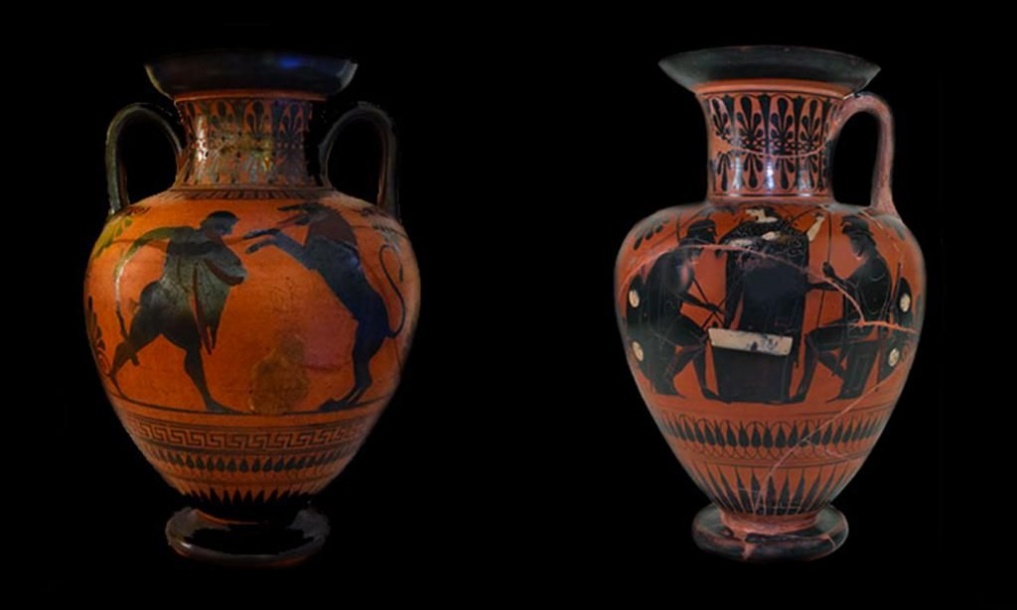
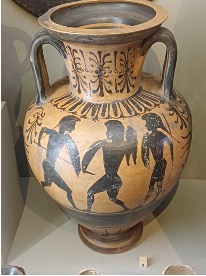 Our task was to collate artefacts from the Ure Museum and its databases to create a temporary exhibit on Achilles, one of the most well-known heroes from Greek mythology. On our first day of work, we met with Prof. Smith, who gave us a quick tour of the museum and taught us the intricacies of curating a museum and the detailed work that goes into the creation of each exhibit, something that is often overlooked by visitors to museums. Prof. Smith explained that the most effective method of curating an exhibit was to find a balance between researching the topic area and simultaneously exploring the artefacts one had at hand to try to create links between them – the exhibition from the largest museums could take years to create!
In order to consolidate and deepen our knowledge, we spent the first day of the project researching Achilles and the myths surrounding him, making good use of the Classics library in 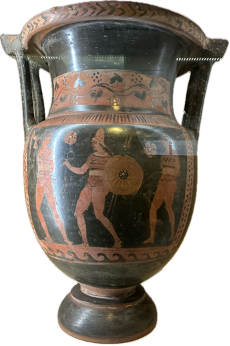 G40. Though we noted significant differences within the story depending on who told them, as with the nature of mythology and the Epic Cycle, – which led us to dive numerous rabbit holes, such as Achilles’s many supposed posthumous wives (including, surprisingly, Medea and Helen!) – we were nonetheless successful in gaining a foundation for our project, allowing us to carefully choose artefacts from the Ure that we thought we could confidently connect to the hero.
At first, we were unsure of how many connections we would be able to find, so we decided to note down even the artefacts with the most tenuous of links, following close inspection of various pots to determine whether the men depicted were beardless. Thankfully, we were pleasantly surprised to discover that the museum and databases had lots to offer that could be linked to Achilles; though it is impossible to confirm the true identities of the figures shown, or the actual events that the scene represents, as is the nature of the study of classics, we could use our deductive skills to make reasonable assumptions that it could indeed be Achilles.
This led to the difficult task of significantly narrowing down our longlist of artefacts, whose total had reached the dizzying heights of the 60s – ultimately, we decided that the best approach would be to categorise the myths we had read into themes in order to give structure to our exhibit. After comparing the research we had done with the artefacts we had found, we came up with four key themes: his early life and family; his signature traits; his role in the Trojan War; and his death. This made curating our shortlist – 27 artefacts in total – much easier, though we both found difficulty in the sacrifice of particular favourites, and we had to try and find a balance between the themes. Inevitably, we found that most of our artefacts linked most strongly to the theme of the Trojan War, as that is where much of Achilles’s fame is rooted; despite this, our final selection – 20 artefacts – had fairly even distribution across Achilles’s life. One thing we found particularly surprising was the number of gemcasts that were explicitly related to Achilles and the Trojan War, including a significant number depicting fights over fallen comrades’ bodies, which can be applied to a key moment in the Iliad – and one very personal to Achilles – the death of Patroclus.
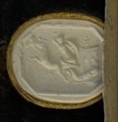 Pictured right: a gem cast showing Achilles dragging Hector’s body around the walls of Troy
The final phase of the project consisted of cohesively ordering the themes and their corresponding artefacts, and writing the descriptions which linked them to certain myths, thus creating an overarching storyline covering the key aspects of Achilles’ mythology. Once we had finalised and reviewed our project, we met with Emma to present our work.
We would like to thank Professors Emma Aston and Amy Smith for an incredibly valuable experience. We loved getting first-hand insight into the process behind curating a museum exhibit, as well as developing our research skills and learning about university life – skills that will be incredibly useful to us as prospective Classics students. The week has given us a lot to think about regarding potential future careers in academia, and we look forward to seeing the exhibit in person – hopefully in the near future!
By Moya and Caitlin - Year 12