Moya's Success at German Essay Competition
If there is something which unites the whole of humanity, it must be our ability to tell stories. This is the one thing which allows us to put ourselves into the mind of another, to be able to understand and sympathise with experiences such that we can never personally experience. Therefore, when the Department of Languages, Literatures and Cultures at King’s College London invited A-Level German students around the country to imagine ourselves as citizens of early 20th century Germany, and write an account of our experience perceiving a certain technological advancement for the first time, I was very keen to take part.
The exact prompt was created to honour the 125th anniversary of the Wuppertal suspended railway, which first opened to the public in March 1901. We were to imagine ourselves as the first passengers aboard this rail. This was the first railway of such a kind in the world, and, given the particular historical context of Kaiser Wilhelm II’s turbulent and eventful reign within a recently unified German nation-state, I thought it worthwhile to attempt to write a piece that reflected a civilian’s experience, not just of a new spectacle, but about the experience living in the society that created it.
I chose to write from the perspective of a young man, a budding Socialist not yet eligible to vote, still with an innocent sense of pride in his nation, eagerly describing the Schwebebahn to his older sister (who is part of the first-wave feminist movement) and exploring the idea of social advancement’s compatibility with technological advancement. I also took some time to briefly look through germanletters.org to try to best match the tone and structure of a German letter-writer in the 1900s (though quickly gave up on making the writing style period accurate!), and researched the Schwebebahn itself to not fill my text with historical inaccuracies.
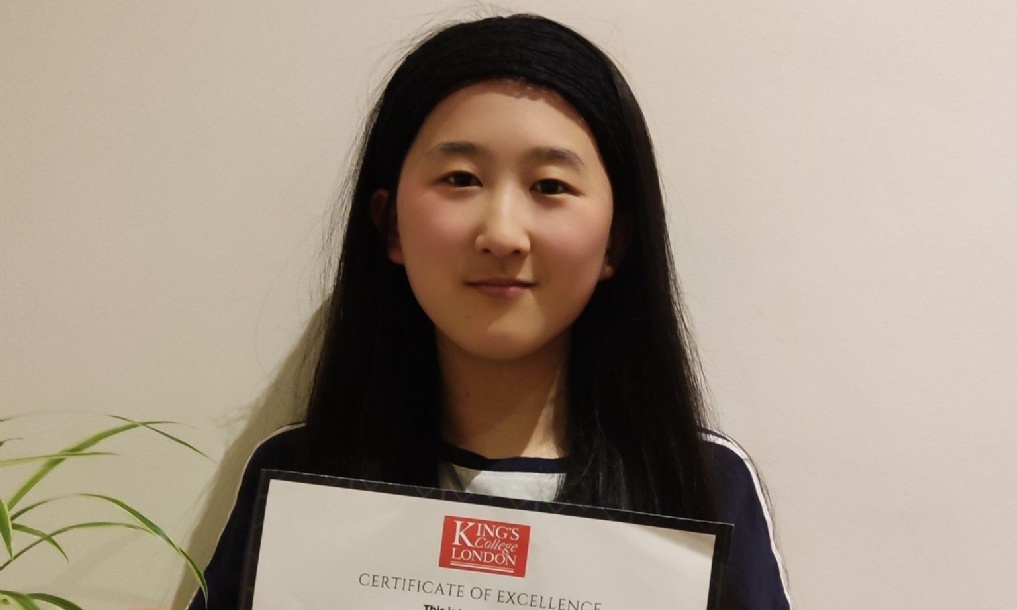
Imagine my surprise when I was sent an email a couple of weeks ago, announcing that I was the runner-up in the competition! The other participants and I were invited to a workshop and prize-giving ceremony at King’s College. The workshop included a lecture about medieval literature and translation – emphasising how deeply interconnected language has always been to cultural identity. It was interesting to consider how even with literary translation today, the language a text is written in can completely change its tone and the reader’s perspective on it. We then had a fascinating discussion about what it meant for a country to develop technologically – trying to consider how different members of the populace might react to such a thing, and whether such development is overall positive or negative.
All in all, it was such a fun experience, and I am very grateful to King’s College London for organising the competition!
By Moya - Year 12